Showing posts with label Lagos. Show all posts

Monday, June 24, 2019

Worshippers seek TB Joshua's blessing in Nazareth


NAZARETH: Celebrity Nigerian Pastor TB Joshua attracted Evangelical Christians to Israel for a crusade, a mass faith-healing service outside Jesus's hometown of Nazareth on Sunday.

Some worshippers sang in various languages during the powerful gathering, presided over by TB Joshua, who has amassed millions of followers on social media from his base in Lagos.

"Jesus's father, Joseph, and his mother, Mary, came from here. What a blessing. No other place would have been better for Jesus to come from. It was God's design," Joshua told the crowd gathered in a sun-baked stadium on Mount Precipice.

When the self-described prophet descended from the stage to bless attendees, placing his hand on their heads, several declared themselves healed from sickness or infirmity. Attendants stood ready to catch those who fainted in excitement.
Minerva Resendiz, from Mexico, said she had come to see Joshua as part of the two-day gathering "to ask for healing, for a breakthrough ... to resolve conflicts in the family".


"I would like that (all people) could see a miracle through Jesus Christ," Resendiz, 40, said. Other pilgrims came from China, Russia, and African and South American countries.

Joshua founded and leads an evangelical ministry called The Synagogue, Church of All Nations. His Christian television network, Emmanuel TV, says its Youtube's channel is the most subscribed with well over one million followers.

Evangelicals made up roughly half of the more than 2 million Christian pilgrims who visited Israel in 2018, according to the International Christian Embassy in Jerusalem, which oversees evangelical outreach to Israel. 


REUTERS

Thursday, February 21, 2013

Forced migration: Concern over displaced persons’ status


Makoko community is a clustered community of mainly fishermen and artisans that live on the shores of the Lagos Lagoon.
Makoko
With population explosion in Lagos, Nigeria’s mega-city of about 18 million people, the residents of the community have been faced with threats of forced eviction and demolition of their homes.
The recent eviction which took place in July 2012, according to the Lagos State governor, Babatunde Fashola, was to make the state attain her mega-city status and beautify the waterways being defaced by scattered, irregular shanties along the Lagos Lagoon shoreline.
The ensuing scuffle resulted in the death of a community leader who was shot by a Police officer, leading to a peaceful protest by residents to the Governor’s Office at Alausa to kick against their eviction. The residents argued that they have come to live and know the area as home because their forefathers lived there for decades.
Fashola told them that those residing under high tension electric wires would leave so as to ensure their safety. He described the Lagos Lagoon as a natural drainage for excess floodwater and that the continuous indiscriminate expansion of shanties on the Lagoon was shrinking it.
He added that, for Lagos to attain the much-desired megacity status, her waterways have to be clean and free for water transportation, which is being negated by the construction of shanties at Makoko.
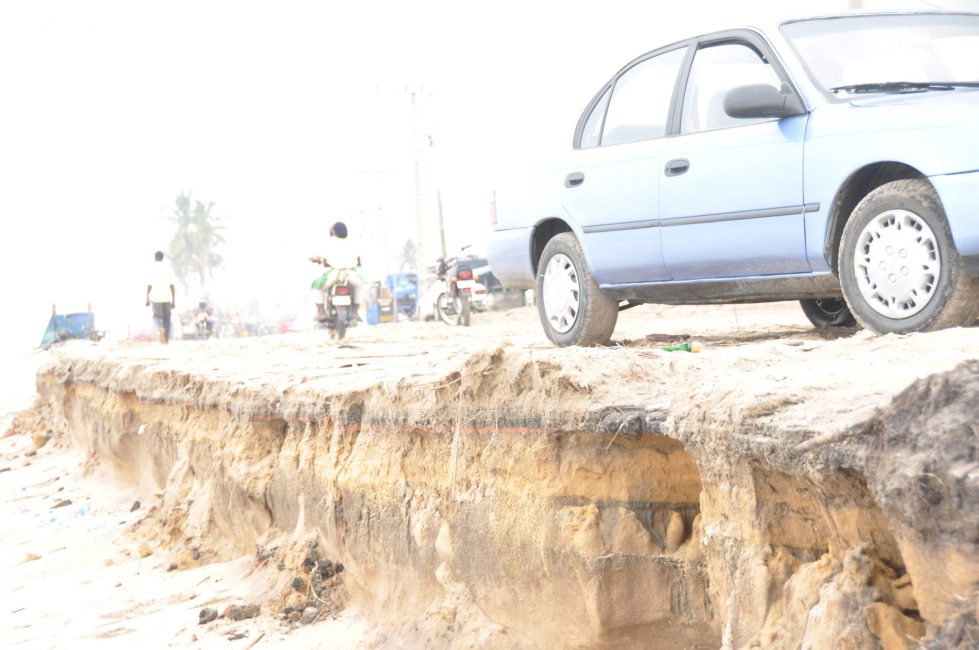
Makoko residents are forced to move due to urban development concerns, but the Okun-Alfa community in Lekki at the Eti-Osa Local Government Area have been left with no choice but to relocate their homes as the rampaging Atlantic Ocean continues to erode much of the land that the once-thriving settlement stood. Experts have attributed the scenario to climate change-induced.
Okun-Alfa community hosts one of Lagos’ popular fun spots known as Alpha Beach but, in recent years, the area has experienced sea level rise and shoreline erosion that have washed away about 10km of land, threatening the community’s sources of livelihood: fishing and tourism.
Shoreline erosion at Okun-Alfa
According to the oldest man in the community, the 100-year-old Alhaji Mudashiru Atewolara, who passed on recently, he built five houses in his life time but only one still stands as others have been washed away by the advancing sea.
The ocean has also washed away the only tarred road that links the settlement with neighbouring communities, uprooted electric poles and leaving about 5,000 people without electrical power supply, washed away the fence of the only health care centre in the area and thus threatening the facility and leading to its abandonment.
The once-lively Alpha Beach that used to attract fun seekers at weekends and public holidays is now a ghost town. Business activities in the area have been paralysed to below 20 percent of what hitherto existed.
The infamous July 2011 torrential rainfall in Lagos got the entire neighbourhood flooded, including the access road linking the community with the Lekki-Epe Expressway, which further deteriorated and ultimately became inaccessible to vehicular traffic.
The community’s Baale, Chief Atewolara Elegushi, lamented the pollution of the underground water, saying that highly-publicised visits to the neighbourhood by Fashola and President Goodluck Jonathan have yielded no fruit.
Climate-induced migration was one of the topics discussed during a side event at the United Nations Climate Change Conference that held late last year in Doha, Qatar. Climate-induced migration is attributable to flooding due to excessive rain, continuous sea level rise as experienced in the small island countries, shoreline erosion, drought, hurricane, and poor crop yield (which leads communities to migrate to greener pastures in search of viable land for agriculture). Other factors that can force residents to migrate include urban development, earthquake and landslide.
A recent report states that, by 2050, one in every 45 persons in the world would have been displaced due to sea level rise, with India, Bangladesh, China and Nigeria having the highest population of 37.2, 27, 22.3 and 9.2 million people respectively.
When people have to migrate due to imminent danger, the issue of losing their ancestral homes, culture and root is quite challenging due to the emotional and psychological trauma they experience. They are also vulnerable to abuse and violence by their new hosts.
Nigeria’s Environment Minister, Hadiza Mailafia, while addressing the African Group during the Doha summit, stated that two-thirds of states in Nigeria were flooded last year (2012), leaving many to abandon their homes and migrate to higher grounds and some accommodated in emergency relief camps, where there were cases of raping of some of the internally-displaced females. Similarly, limited supplies of basic needs made people to resort to the use of sex as weapon of survival.
Due to development of urban areas in Brazil, some people were forcefully evicted to give way for the construction of modern stadiums, in the build-up to the 2014 World Cup and 2016 Olympics Games to be hosted by the country.
Reports have it that about 170,000 people have been affected by this construction in Brazil, which has made some view the international games as a pain rather than a thing of joy and pride in hosting two of sports’ highly-rated events.
Since the earthquake in Haiti in 2009, more women have been sexually abused and exploited, said CNN 2012 Hero recipient Marla Villard-Appolon. This made her start a rescue mission to rebuild the confidence of the abused women through her programme that received international support by CNN.
The status of these migrants has brought about border migration, division of nation/states, which can cause fascism and xenophobic tendencies among their host, such as the case in Nepal, The Philippines and Vietnam. The migrants could also be exploited due to immigration and labour laws in their new country.
It will be wise for victims of climate- and urban development-induced migration to be considered and planned for because, with the increasing world population and growing effect of climate change, there would soon be a generation of classless/statusless citizens.

By Tina Armstrong-Ogbonna
tyna4u2me@yahoo.com

Monday, March 19, 2012

Porsche unveils 21 million naira luxury 911 sports car


LAGOS German car-maker Porsche officially opened a new car dealership on Friday in the heart of Lagos' wealthiest district, Victoria Island, a place with one of the world's highest concentrations of millionaires. There are already dealerships specialising in Aston Martin and Lamborghini, but Porsche hopes to capitalise on a promise of providing sturdier vehicles that can cope with Nigeria's hard roads. Its presence is being seen as a vote of confidence in the West African nation's fast-growing economy. 
  •  Porsche also plans to set up an operation in the capital Abuja, where roads are newly built - a better market for the 911 sports model - and where politicians are amongst the world's most highly paid.        
  •  "The African continent, and in particular Nigeria, is of growing importance to us at Porsche," the company's Middle East and Africa head George Wills said, unveiling the new 911 model.    High-end goods producers are increasingly targeting sub-Saharan Africa, as its economic growth starts to dwarf other continents and rich Western countries face a slowdown.
  •  Nigeria, Africa's second biggest economy, grew 7.68 percent in the last quarter of 2011, one of the fastest in the world.
  •  Two of Africa's top five richest men are Nigerian.       
  • "We're quite confident the numbers will be strong," Wills said in front of the new 911 sports car, after a Porsche official revved its engine for flashing cameras.        
  •  "It's difficult to put a finite number on it, but certainly enough to give a return on this investment," he added.
  • Porsche Nigeria general manager Julian Hardy estimates 200 Nigerians own Porsches - the dealership had been running prior to the official launch since July and sold an undisclosed number, and rich Nigerians have been importing them for decades.         
  • At a party to celebrate Porsche's launch, Nigerians in sharp suits and cocktail dresses drank martinis and danced around the 911 display model to live music.
  • "You can drive around Lagos ... then take your car to the race track and become a beast and go wild," said Emmanuel Ngala, an IT consultant who owns a Cayenne 4x4 and is buying a 911.      The firm's sales target for 2012 is 100 cars, and it hopes to hit a stable sales rate of around 300 a year, compared with 800 in South Africa. Average prices currently range between 21 million naira ($133,000) to 30 million naira ($190,000).    
  •  Lagos embraces some of Africa's most expensive real estate alongside some of its most crowded slums.
  • The car park at the Porsche show rooms has several models.     
  • "It's a nice car," said employee Mohammed Ibrahim, as he hosed down a chrome coloured Cayenne and shined it to a sparkle with a cloth. On his 20,000 naira, a month salary it would take him 125 years to afford one if he did not buy anything else.        
  •  "God might give me a car like this one day. He can do that, if he wants to. He can do anything," he said, grinning.   
  •  Sandwiched between the lagoon that led Porteguese sailors to name this city 'Lagos' and the Atlantic, Victoria Island is a place of fund managers in fine woollen suits and oil oligarchs.     
  • The faces of glamorous women smile from billboards advertising mobile phones. Luxury 4x4s are everywhere.         
  • Other luxury brands have however made it big in Nigeria. It is a significant African market for LVMH. Most bars can get you Moet & Chandon champagne or Hennessy brandy, which women sip next to their Louis Vuitton handbags.
  •  The "Auto Lounge" in Victoria Island lets you enjoy an expensive drink overlooking a garage of Aston Martins.
  •  Paris-based magazine Jeune Afrique last year placed Nigeria at the top of Africa's champagne consumers, guzzling 593,000 bottles in 2010, 50 percent more than richer rival South Africa. ($1 = 157.6000 naira)  

Monday, February 06, 2012

Etihad Airways announces new flights to Nigeria


ABU DHABI  Etihad Airways today announced the launch of flights to Lagos, the airline’s first destination in West Africa, from July 1, subject to regulatory approvals.
 The direct flights will link Abu Dhabi and Lagos six times a week and will be operated by a two class A330-200 aircraft with 22 Pearl Business class and 240 Coral Economy seats.
 Lagos becomes the 83rd destination in Etihad Airways’ global network and the return flights will create a new link between Nigeria, Africa’s third largest economy, and the United Arab Emirates.
 Following the launch of services to the Seychelles in November 2011, Tripoli last month and Nairobi in April, the addition of Nigeria marks another milestone in Etihad Airways’ African expansion plans.
 James Hogan, Etihad Airways President and Chief Executive Officer, said: “The launch of services to Lagos is consistent with our strategy of targeting areas of strong growth in emerging markets.
 “The United Arab Emirates is a major trade partner of Nigeria, which has a population of more than 150 million people, the largest in Africa and the seventh biggest in the world.
 “The country is rich in natural resources, such as oil and natural gas. Our new point-to-point services will strengthen the oil and gas links between the UAE and Nigeria and facilitate further growth in these industries.
 ”The country is also enjoying strong economic growth driven by significant foreign investment, particularly from China, which means there is increasing demand for travel between Lagos and other emerging economies.
 “The Lagos schedule will provide seamless connections over Abu Dhabi to key North and Southeast Asian destinations and markets in the Indian Subcontinent and Australia.”

Proposed flight schedule:
Flight #
Departs
Departure Time
Arrives
Arrival Time
Frequency
EY671
Abu Dhabi (AUH)
10.00am
Lagos (LOS)
2.45pm
Three per week: Monday, Tuesday, Saturday
EY672
Lagos (LOS)
8.00pm
Abu Dhabi (AUH)
6.55am
EY673
Abu Dhabi (AUH)
2.25am
Lagos (LOS)
7.10am
Three per week:
Wednesday, Friday Sunday
EY674
Lagos (LOS)
8.50am
Abu Dhabi (AUH)
7.45pm


Monday, January 16, 2012

How Nigeria's general strike started


ABUJA  Nigerian unions on Monday ended a week-long nationwide strike which had paralysed Africa's most populous country, after the president agreed to lower petrol prices.
Here is how the strike unfolded in the continent's biggest producer of crude oil:
JANUARY 2012--
- 9: Tens of thousands of people take to the streets on the first day of an indefinite general strike to protest at the doubling of the price of petrol. Unions demand that the government reinstate fuel subsidies, whose suppression on January 1 led to a sharp increase in petrol prices.
At least six people are killed, including two in clashes with the security forces in the northern city of Kano. A police officer is accused of killing one person in Lagos.
- 10: Security forces disperse thousands of protesters in the north and protesters set up roadblocks in Lagos.
- 11: The two unions representing oil workers threaten to disrupt the production of crude oil.
- 12: Union representatives meet President Goodluck Jonathan, the first direct dialogue since the start of the movement.
- 13: Demonstrations continue, including in Lagos, where some 2,000 Muslims observe Friday weekly prayers on the main protest site. Ten thousand other demonstrators shout anti-government slogans. The unions announce that protests will be suspended during the weekend to allow residents to stock up on food and supplies and for negotiations to take place.
Since the start of the strike movement 15 people have been killed in clashes with police.
- 14: Government and unions fail to reach agreement on the price of petrol. Unions blame the government for the failure of the negotiations.
   - 15: In Lagos long queues form in front of petrol stations in several parts of the economic capital.
   Overnight, unions decide to call off street protests due to security concerns, but say the strike will remain in place.
- 16: President Jonathan announces a cut in petrol prices of around 30 percent but says the government will "continue to pursue a full deregulation of the downstream petroleum sector".
Security forces occupy main protest sites and later fire tear gas, shoot into the air and use armoured vehicles to disperse protesters in Lagos.
Unions announce they are suspending the strike. Union officials say that even after the decrease the price of petrol remains too high, but are ready to engage in further negotiations with government representatives.

Saturday, January 14, 2012

Nigerians rush to stock food after strike

LAGOS Weary and hungry, scores weave their way through rutted and chaotic alleys in a food market in Lagos city, seeking to replenish their food stocks after a week-long strike against soaring fuel prices shut down the country.
Roads to Mile 12 market, Lagos's largest food market, were jam-packed with vehicles as people jostled for parking space.
One woman, a shopping bag in hand, stops by a stall selling yams, a staple food in Nigeria. The vendor says his price. She walks past -- it's too expensive -- but steps back.
"I have to buy. It's food. We have to eat," said Funke Kayode, a furious 45-year-old mother of two.
But both sellers and buyers have one common problem: food prices have hit the roof.
"The price of yam is high. All the same, we still have to buy because we have to eat," lamented Olabisi Adekoya, a mother of four.
Traders say prices have been affected by the hike in transportation costs since fuel prices went up.
Fish trader Oluwatoyin Oluwaseun has not sold much.
"Although many people have come, very few are buying due to the high price," he said.
In some cases prices of vegetables such as tomatoes have risen seven-fold after fuel prices abruptly more than doubled in Nigeria since January 1 when the government lifted subsidies on petrol prices.
The decision sparked anger, and labour unions called an open-ended strike which totally shut down Africa's most populous country for five days.
Sunbo Ahmed said a basket of tomatoes now costs 7,000 naira, up from 1,000 naira last week.
For Abiola Ayansanya the strike has brought misery to her family.
"I came out today because I am hungry. No money. No food. We are suffering. My children suffered a lot during the strike," she said.
"Some of them were crying for food but the older ones were able to show some understanding. Government should go back to 65 naira," she said.
   A decision by the government to end petrol subsidies without warning brought tens of thousands of people out into the streets in protest during the week.
   The decision caused petrol prices to more than double overnight, from 65 naira ($0.40, 0.30 euros) per litre to between 140 naira and 145 naira.
   Strike organisers ordered a two-day pause on Saturday and Sunday to allow people to stock up food in case unions and government fail to reach a deal. Government and labour representatives held a first round of talks on Thursday and began meeting again late Saturday. Unions are sticking to their guns, refusing accept any deal but a return to the old petrol price.
The talks are to take place with government under intense pressure after the country's white-collar oil workers' union PENGASSAN threatened to stop production at midnight if no deal is struck.
Most of the population of Africa's leading oil producer live on less than two dollars a day and see cheap petrol as the only benefit they get from their largely inefficient and corrupt government.
"Everybody is angry and hungry. We voted for (President Goodluck) Jonathan so that he can improve our condition," said Muda Ogunniyi, a 25-year-old driver reading newspapers near the market, summing up the mood in the country of 160 million people.

Friday, November 25, 2011

France loans Nigeria $100 million for buses

   
PARIS France has promised it will loan Nigeria $100 million to set up a bus network in its sprawling commercial capital Lagos, the foreign ministry said on Friday during a visit by Nigeria's President Goodluck Jonathan.
 "In coordination with Nigerian authorities, the French development agency, on the ground since 2008, has made urban development one of its operational priorities in this country," a statement said.
 France said the loan would be made to the Nigerian federal government but then passed to Lagos State. It will help fund the city's new $330 million urban transport plan, which is co-financed by the World Bank.
Lagos is sub-Saharan Africa's greatest metropolis and the commercial hub of Africa's oil-exporting largest nation, but its public infrastructure struggles to cope with its vast population.
Jonathan and his finance minister former World Bank managing director Ngozi Okonjo-Iweala are on a working visit to Paris to drum up trade and investment from France, which has growing oil interests in Nigerian fields.

Friday, September 16, 2011

Rotimi Amaechi leads 5 Governors to US Investment For

The Executive Governor of Rivers State and chairman of the Nigerian Governors Forum Rt.Hon Chubuike Rotimi Amaechi, will lead a delegation of six state governors from Benue, Cross River, Katsina, Imo and Ogun to participate in an Investment Forum on Nigeria at the Woodrow Wilson International Center for Scholars Washington DC on Monday 19th September.

The Forum will draw participants from the United States business community as
well as funding agencies. It is organised by the Center in collaboration with two
other organizations;

Africare and Constituency for Africa, all based in the US
capital.

During his two day visit, the Rivers State Governor will also be speaking at
another breakfast session to select members of the Nigerian Working Group at
Corporate Council on Africa and at the renowned Center for Strategic
International Studies, a renowned policy think tank.

Rt. Hon. Chibuike Rotimi Ameachi is one of the Governors alongside Raji
Fashola of Lagos State who have raised the bar of infrastructural development in
their various states by making huge investments.

He recently embarked on the development of a brand new city known as the
Greater Port Harcourt City. The aim of the project is to decongest the
overcrowded city of Port Harcourt and create new jobs opportunities for the youth
population who hitherto have found past time in restiveness.

Speaking on the visit, Uche Igwe, a former Africa Policy Scholar at the
Woodrow Wilson International Center for Scholars and now Visiting Scholar at
the Africa Program at SAIS Johns Hopkins University Washington DC said
Investment at the state level is critical to transformation of rural communities.

His words “we are happy that our Governors are visiting for talk to US investors.
The level of infrastructural development needed in Nigeria is quite huge.

“Investment at the state level is critical to transformation of rural communities.
Nigerian States need the support of external actors and smart investors
especially in the Niger Delta. Governor Rotimi Amaechi is leading the way which
hopefully his colleagues will emulate.”

Sunday, July 10, 2011

Heavy rainfall cripples Lagos

On Sunday the city of Lagos was crippled as heavy rainfall rendered the state impassable,the roads were rendered unmotorable, while residents in some areas struggled to salvage their household items from the flood.

Vehicular and human movements, including commercial activities in Lagos, Nigeria’s commercial hub were paralysed.
The rain, which started at about 5am in most parts of the state, lasted till late into the night, flooding homes and roads across the state.

Meanwhile, Governor Babatunde Fashola declared a public holiday for all public schools in the state.

According to a respondent based in the Netherlands; If the Lagos state government had concentrated on effective flood control measures across the state we would have have been able to control the flood levels. The Netherlands is below sea but they have been able to control flood by building a network of canal which run through their cities. Lagos needs 30ft wide flood channel that will act as storm drain along every major street. BRF had better discontinue the Eko Atlantic project and concentrate on building proper drains for Lagos, in doing this only competent construction firms track records most be engaged, not the likes of Hitech who invert 3ft culvert across a highway as drains check Lekki expressway and the disaster they 've created in the Area. If heavy rain fall can bring us to a halt what will high tides and ocean surge ..

The ministry of Environment started a drainage project Last year in Lekki during the rains, the contractors abandoned that project on Silverbird Tv road and Agungi area till date. The question is. How do you start a drainage construction job in the peak of the rainy season only to abandon it during the dry season ?? its the same across the state.

Saturday, July 09, 2011

Nigerian woman with five babies on the NHS cost £200,000 is married to a richman


If the report published in the Daily Mail Newspaper that a Nigerian woman who traveled to Britain to give birth to quins at the taxpayer’s expense is married to a wealthy businessman, then the woman and her husband must be brought to book.

Not only have they successfully embarrassed and disgraced Nigeria, they have also proven why the average Nigerian even a pregnant woman can't ever be trusted.

The woman, Bimbo Ayelabola, 33, had two boys and three girls in April by caesarean section and remained in hospital for almost two weeks, costing the NHS up to £200,000.

According to the Daily Mail she came into the UK with a visitor’s visa, which has expired and she is now fighting to remain in this country, claiming a return to Lagos, Nigeria would leave her homeless and without a ‘support network’ to help her raise her five children.

However the report revealed that her husband, who remains in Nigeria, is a wealthy businessman. A University graduate Ohi Nasir Ilavbare is chief executive of his own logistics company whose clients include British American Tobacco and DHL.

He also owns and runs an upmarket hotel and business centre in an exclusive suburb of Lagos, where his company, Spry Logistics, is based.

Here are comments by British nationals, what's your take?
Brian Spennymoor, Well are we really surprised.....Just wait until her extended family start arriving claiming they have the right to live here because of "Human Rights"....this country is the dumping ground for the worlds rubbish...Thanks "Dodgy Dave" you certainly did away with the Human Rights Act....Well didn't you....Well less than four years to go and the clock is ticking.
- Brian, Spennymoor

Jim Dyer, Disgraceful! They should be sent back immediately and the NHS bill paid by her husband. No way should she be allowed to soak the benefits and welfare system here like many others do. They both wanted a lot of children so hey should support them in Nigeria

Richard Clarke, How much longer are the British people going to put up with this abuse of the NHS and all the other freebies handed out to people who have no right to them. This woman is a disgrace, but then so are the authorities for allowing these situations to continue on a regular basis without any intervention.

Anonymous, When is this government going to enforce an overhaul on the system.These people from the developing countries are taught to deceive.lt is a learned culture to get what they want through deceptive means.They do not give a dam about compassion. Stop them before they even enter Britain by using policies that has laws of commonsense. So,not Britain has become the baby breeding incubator of the world now.l feel so ashamed with this system of ours
Anonymous

Vicky, "get out of our country!!!!!!"

Saturday, July 02, 2011

British Taxpayers pick up £200,000 bill to care for Nigerian mother

A Nigerian mother who flew into Britain when she learned she was pregnant and had quintuplets has cost taxpayers an estimated £200,000.
The health tourism row erupted after it emerged Bimbo Ayelabola, 33, has asked the Home Office for a six-month extension of her visa which expired last Monday.
She claims that the children - boys Tayseel and Samir, and girls, Aqeelah, Binish and Zara - are too fragile to take back to Nigeria.

They were born at Homerton Hospital, in Hackney, east London, by caesarian surgery at 32 weeks on April 28.
Ayelabola also says that all her friends and family live in the UK and she has no 'support network' in Lagos where she lived.
Her husband visited her in hospital but flew back home after discovering it was a multiple pregnancy and he faced having to care for his big family..
She said: 'If I go back I'll be on my own without even a roof over my head.'

Ayelabola, now living in a two-bedroom flat in Poplar, east London, was reported to have been taking twice the prescribed dose of a fertility drug when she became pregnant.
Soon after discovering she was expecting, Ayelabola quickly obtained a UK visitors' visa. On arrival, she had an emergency NHS scan which showed she was expecting quads.
Doctors only discovered the fifth baby during the caesarian operation.
She told the Sun: 'I had already had miscarriages and couldn't bear the stress another pregnancy would cause.
'I thought I would stand a much better chance of avoiding another miscarriage in a calmer place with friends and family.'
Ayelabola may still have to pay the cost of her care which includes treatment by consultants, midwives, paediatricians and social workers.
But Home Office officials know she will be unable to pay the bill.

A spokesman said: 'The NHS is a national health service not an international one. We expect those with no rights to be in the UK to leave otherwise we will remove them.'

Monday, May 16, 2011

NBC staff paralyses operation in Lagos

The bulk of casual staff of Nigerian Bottling Company(NBC), the authorized bottler of Coca–Cola products and the leading producer of Alcohol-free beverages in Nigeria numbering about 500, took to the streets in Lagos, protesting over poor working conditions and inhuman treatment by the management of the company.

The protesters practically shut down operations as all entrance gates to the company were closed. Although, police personnel were not on ground, the atmosphere was tense.

The aggrieved workers started the protest around 8am, carrying placards and singing.

The protesters said the management has over the years refused to see to their welfare. Some of the things they complained about include: poor remuneration, harsh working condition and lack of medicare, amongst others.

A top executive was quoted to have said "We are aware that there was a demonstration on Monday, by a number of persons at the Ikeja Plant of the Nigerian Bottling Company Plc. These are people who have been engaged through service providers for the plant.

"The Company is currently having internal discussions about the situation. It is our desire to resolve this matter swiftly, amicably and equitably.It is not appropriate to go into details while these discussions are continuing. However, further information will be provided at the earliest opportunity," it said.

A protesting staff said the strike will continue today if the company does not invite the workers for dialogue.

Saturday, April 16, 2011

Nigeria Live Election Results

ELECTION RESULTS:

April 16, 2011 03:26PM


Presidential election result at GRA, Ikeja/police barracks Ward


LA01/11/09/025a


A total of 168 votes cast.


>>CPC-29

>>ACN-41


>>PDP- 73


>>PPP-1


>>PDC-1


>>Invalid:12


Result at polling Unit Ayangburen road, Ward 007, Ikorodu, Lagos.

PDP-85
ACN-61
CPC-10
ANPP-1
PDC-1

NCP-1
MPPP-1


Presidential election result at GRA, Ikeja/police barracks Ward 2:
LA009/091/124.

Total votes cast: 195

>>ACN-29
>>PDP-118
>>CPC-41
>>PDC-3
>>FP-1
>>ADC-2
>>Invalid: 1

Thursday, October 14, 2010

T B Joshua blacklisted in Cameroon

The Cameroonian government has blacklisted Prophet Temitope Balogun Joshua of the Synagogue Church of All Nations, saying that he is an agent of Satan hoodwinking unsuspecting members of the public with “diabolical miracles”

Cameroon Foreign Affairs Minister, Mr. Henri Eyebe Ayissi, in an official communiqué he issued this week titled “The Devil Is In the House”, described T.B. Joshua as a “son of the devil” pretending to be “a man of God”.
The Minister warned hundreds of Cameroonians trooping to Lagos, South West Nigeria, for miracles in Joshua’s church, to desist from taking the trip or face the consequences as the country will not stand by them.

The communiqué written in French reads in part “The Ministry of Foreign Affairs warns those who by naivety or deception of Emmanuel TV’s captivating images, or even those who by hopelessness, envisage taking the pilgrimage to Pastor T.B. Joshua’s Synagogue Church Of All Nations in Lagos, that they will do so at their own risk.

“The Cameroonian Government warns these pilgrims that they will face the consequences alone. This is motivated by the painful and shameful fact that Cameroonian men and women, in search of deliverance and blessings, once in that church, find themselves in bestial and pitiable conditions.

“Women are raped; pilgrims dispossessed of their belongings by armed robbers and left to sleep in the streets at the mercy of gangs. Many cases of assassinations have even been recorded. And this is without other cases that are not recorded at the Cameroonian Embassy in Lagos with the victims too ashamed to narrate their infernal odysseys once they are out of Hell,” the Minister said.

The Minister said that while the bible asks us to be discreet with gifts and donations to the poor, T.B. Joshua is seen daily dolling out bags of rice to indigent people.
Cameroonian newspapers which published the communiqué this week tell tales of hundreds of Cameroonians who sold their properties or borrowed money in the hope of getting miracles in T.B. Joshua’s Church, only to be disappointed in Lagos.

The newspapers report that Joshua’s TV station has gained popularity in Cameroon and many people are tempted to take the trip and receive healings and sudden blessings.
It says that Joshua is now in many households in Cameroon and many people believe the flashy images they watch on television.

One newspaper writes in French “witnesses who come back from that pandemonium reveal that to secure an appointment with this Jesus-Christ-reincarnate, they had to spend 150, 000 FCFA (about N50, 000) and the amount keeps going up, depending on the treatment and the case.

“This has led to confusion and disillusionment from Cameroonians, who on their way to Damascus, now find themselves refugees at the Cameroonian Embassy in Lagos.”
The newspaper report says further: “There are many here in Cameroon, convinced of the power and the blessings of this “man of God”. However, they forget that Jesus Christ is in our hearts through faith and with our practice of the Ten Commandments and our relationship with one another. Before the publication of the communiqué by the Ministry of Foreign Affairs, the bible said over 2000 years ago, ‘And Jesus answered and said unto them, Take heed that no man deceives you. For many shall come in my name, saying, I am Christ; and shall deceive many’.”When contacted this morning, T.B. Joshua denied that he has been blacklisted in Cameroon.
He said that Cameroonians who come to his church only heard about him in Cameroon and started trooping to the church in Ikotun, with most of them without accommodation. He said that had he been aware of their presence around his church, he would have provided accommodation for them.

Monday, December 14, 2009

Mushin Lagos gets a facelift


Some 5,000 Nigerian volunteers turned out Saturday armed with paint brushes to give a facelift to Mushin, a notorious slum in the centre of the country's commercial capital Lagos.

Led by Abimbola Fashola, the wife of Lagos State Governor Babatunde Fashola, the volunteers administered paints to seven selected streets in the community, known for being overcrowded and chaotic and plagued with a high crime rate.

Fashola flagged off the ceremony on Saturday morning by painting the first house while more buildings and roadside curbs along the most noticeable and eye-catching parts of the community were painted by the volunteers.

"This is a commendable self-help project and I plead with the organisers to extend the same gestures to other local government areas in the state and the entire country," she said.

The volunteers in the one-day beautification exercise tagged "Mushin Makeover" came from all walks of life including entertainment, security agencies, students, traders, professionals and business and corporate leaders. Mushin residents were excited about the landmark beautification project.

"This is so cool, our old house is looking new with a fresh green paint," resident Rashidat Modupe told AFP after her house had been painted.

"I have lived in Mushin for more than 50 years and this has never happened before," another resident, a landlord, added.

The project was organised by Visible Impact to compliment the state government's ongoing megacity programme.

Nigeria's most populous city with between 15 and 17 million people has decided to overhaul its image.

Fashola said a trip he made to Singapore before becoming governor in 2007 gave him a model on which to base his transformed megacity.

He said focus has been put on revamping the transportation and road sector, improving waste management and water provision, property development and the environment.